
Talent Profiles
Many brilliant people from top schools and colleges come to us trying to decide what to be when they grow up. “Should I be a doctor or lawyer?” some ask. They are pleased to discover that there are lots of different ways to be “smart;” intelligence is not a one-size-fits-all construct. Each of us has a brain, and as far as brains go we all carry the same stock hardware equipment. But no two brains are alike. Our different personalities are the proof.
Just like we all have a face with two eyes, nose, and mouth, no two people look exactly alike. Our individual cognitive ability components are wired up a little differently in each of us. For example, we all have some spatial ability (located in the parietal lobes just behind your ears), but some of us are born with the volume knob on this aptitude turned all the way up and tend to show very early signs as naturals at 3-D thinking tasks. Many spatially oriented people tell me that they continued to secretly play with LEGOs until they were teenagers and some well into adulthood.
The following comparison of the illustrated talent profile samples will show how gifted doctors and lawyers have very different natural talents and innate abilities. If happy doctors are natural born super mechanics, happy lawyers are born philosophy professors. Interestingly, my practice is full of unhappy lawyers who are really cut to be doctors who didn’t discover their natural gifts until they were well into their 30s and 40s.
What does the Careerfinder aptitude testing measure? Following are talent profile samples for a Family Doctor, Constitutional Lawyer, and E.R. Surgeon.
Profiles
Talent Profile Samples — Family Doctor, Constitutional Lawyer, ER Surgeon**
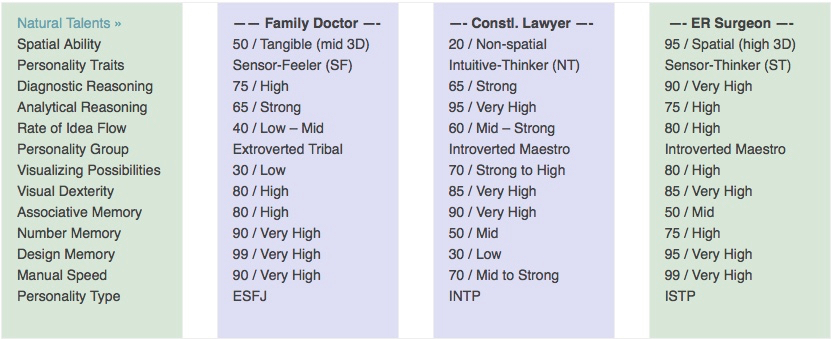
**Natural Ability Battery Sample: The above talent profile samples are truncated and simplified for demonstration purposes. The numerical scores fall within ranges (low, mid, strong, high, and very high) and have percentile rankings to indicate the natural potential or strength of each ability. The Careerfinder Program steps you through an ability battery of aptitude assessments, measuring a comprehensive talent profile of 16 innate talents, traits, natural abilities, personality type and temperament.
The following tabs discuss a talent breakout and comparison for the fields of medicine and law . . .
Spatial or Not?
Spatial Ability
 One major difference talent difference between medicine and law is in the ability to spatially visualize 3-Dimensional objects in your mind’s eye. Most doctors need to have a natural Spatial ability to fully grasp the inner workings of the human anatomy, they read x-rays in the same way an architect reads a floor plan, mentally converting 2-D images into 3-D forms.
Why is the spatial ability so important for the practice of medicine? The human body is a complex physical system, doctors who love their work are natural troubleshooters of spatial problems.
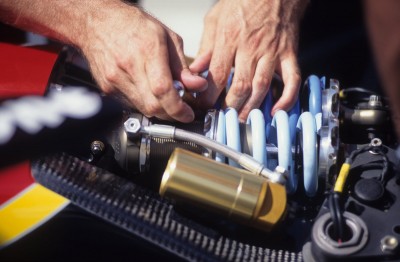 One ER surgeon went on to become a race car mechanic, he was into operating quickly on supped up car engines. We’ve also met unhappy doctors who didn’t realize they were low in the spatial talent, unfortunately you can’t dramatically improve this talent if you weren’t born with much of it. Lots of non-spatial dentists, chiropractors, and veterinarians have told us they suffer from undue stress worrying about making critical mistakes with their patients.
A lawyer doesn’t need to think spatially to do her job. The vast majority of lawyers use the opposite Non-spatial talent to work with abstract legal concepts. We’ve also met hundreds of bored lawyers who were really cut out for spatial careers like medicine, many spend their weekends happily doing home improvement projects to exercise this untapped ability.
Personality
Personality Traits
The Temperaments of doctors and lawyers are the exact opposite, they are worlds apart when it comes to personality traits. Family doctors who love their jobs are warm, caring and friendly, they think of themselves as healers. Gifted lawyers tend to be highly objective and rational, many are fiercely competitive and often have the “killer” instinct needed to play hardball in the legal system.
Personality-wise, most happy doctors in clinical practice are at least 65% Extroverted, they spend much of their day seeing a steady stream of patients. Most happy lawyers are strong Introverts, they regularly spend 80% of their day working quietly alone, except for trial lawyers who have to make occasional performances in the court room. A day in the life of a lawyer looks much like a monk in a monastery.
Neither doctors nor lawyers are group workers, they both tend to be Maestros or soloists with an individualist’s distaste for teamwork. Maestros are highly trained experts of a specialized subject area, except for family doctors and district attorneys, where a Tribal personality is suited better to work with broad knowledge of different subject matter in a team-based environment.
Reasoning
Problem Solving
There is one very important aptitude in common among brilliant and highly competent doctors and lawyers, high Diagnostic Reasoning (a.k.a. inductive reasoning), a natural ability to leap to accurate conclusions to solve complex problems. Success in medicine and law requires a natural gift for quickly seeing unobvious connections between unrelated clues. There is a major difference, however, in how each uses this ability. Doctors apply life sciences and physical sciences to diagnose 3-D or tangible problems, while lawyers apply social sciences and humanities to diagnose abstract or conceptual problems.
The Analtyical Reasoning aptitude is not as important for the practice of diagnostic medicine, but is the life blood of law. In the heat of the moment, doctors don’t have enough time to solve problems using logic or methodical research. On the other hand, lawyers constantly use the analytical talent for writing and research, as well as for making well-thought-out logical arguments.
Worlds Apart
Unconventional Wisdom
The fields of medicine and law engage very different innate talents, they are worlds apart on the level of what makes you tick. Even within these fields there are different talent sets at play. Surgeons have very different talents than pediatricians. Patent lawyers are quite different from corporate lawyers. The same is true of all the major professions.
The conventional notion of an one-size-fits-all “smartness” has sent many down the wrong road. If you’re unsure of what you’re best at, it would be a very smart investment in your future to know what your natural talents are and how to apply them in the career world.
What Are You Cut Out For?
Curious to know where you fit in? There many, many ways to combine these aptitudes into talent profiles. For example, if you were considering a career in business, it would be good to know whether you have the profile for advertising, marketing research, or high tech entrepreneurship. In the sciences there are major differences in talent between physicists, wildlife biologists and geologists. Same goes with the social sciences, humanities, arts, design, media, engineering, education, healthcare, hospitality, entertainment and all the rest of the professions.
Natural Talents and abilities are your genetic endowment. Some activities come very naturally to you, while your weaknesses will always feel awkward or frustrating to use on the job. Brain research has shown that you can’t vastly improve a weakness, if at all. The way to reach your full potential is to follow your strongest talents and enjoy honing them throughout your lifetime.
~ Anthony Spadafore, senior career consultant and co-author of Now What? The Young Person’s Guide to Choosing the Perfect Career
Learn more: We love talking about this stuff, so feel welcome to tell us about your career situation . . . maybe we can help.


